Modern readers often hear that medieval Scandinavia was an “honor culture,” but that phrase can become vague if it is not defined carefully. In Old Norse literature and law, honor was not just a private feeling of self-respect. It was a public condition: a person’s standing in the eyes of kin, neighbors, rivals, and political allies. Scholars working on the sagas have repeatedly treated honor and shame as central organizing values in this world, while also warning that these ideas were communicated through speech, performance, law, and ritualized social behavior rather than through a single abstract code. Richard Bauman, for example, argues that honor in medieval Iceland was enacted through performance, especially verbal performance, and that reputation and moral worth were publicly recognized through socially legible acts.[1]
That public dimension is the best place to begin with níð. The Old Norse term níð is often translated as “scorn,” “defamation,” or “dishonoring insult,” but none of those English words captures it perfectly. It was not merely rudeness. In scholarship, níð is treated as a form of deep dishonor or socially destructive accusation, often sexualized, often public, and often aimed at stripping a person of standing. Folke Ström’s classic study frames níð and ergi together as key categories for understanding Old Norse moral attitudes, while later scholarship continues to treat níð as one of the most severe forms of reputational attack in the sources.[2]
Honor, shame, and public standing
Old Norse texts do not reduce “honor” to one single word. Modern scholarship points instead to a cluster of terms such as virðing, sómi, mannvirðing, and sæmd, with skömm serving as a common word for shame or loss of honor.[6] One recent study of saga honor language notes exactly this point: the same vocabulary field that expresses honor also has negated or damaged forms that express disgrace. That matters because it shows that honor in the saga world was not an abstract moral possession one simply “had.” It was something that could be increased, defended, diminished, or ruined.[6]
This is why feud, insult, compensation, arbitration, and public speech loom so large in saga literature. William Ian Miller’s work on feud and law in saga Iceland emphasizes that social conflict was not random violence but part of a system in which reputation, obligation, and retaliation were interlinked. Bauman similarly argues that honor in Icelandic society was sustained through public communicative acts.[1] In that sense, an insult was dangerous not only because it hurt feelings, but because it threatened one’s recognized place in the social world.
What níð meant
The term níð is best understood as a category of profound dishonor, especially dishonor made public. It could appear in speech, verse, carved or visual representation, and symbolic acts. It was closely associated with attacks on a man’s fitness, courage, sexual status, and moral worth. A related noun, níðingr, names the dishonored or villainous person, someone marked by social baseness rather than merely ordinary wrongdoing. The seriousness of the category is visible not only in literature but also in law and in the special force given to certain insulting accusations.[2]
One reason níð is difficult to translate is that it sits at the intersection of insult, accusation, stigma, and symbolic unmaking. It was not just that someone had done a shameful thing. Rather, níð could make a claim about what sort of person someone truly was. That is why scholarship on the subject often treats níð as more than invective. It is a public attempt to redefine another person downward, to expose him as unworthy of the status he claims. Anita Finlay notes that scholars have often linked níð especially with sexual insult and with the cluster of ideas summed up by ergi: effeminacy, cowardice, and moral baseness.[3]
Ergi, argr, and the logic of dishonor
To understand níð fully, one must also understand ergi and the adjective argr or ragr. These are often translated as “unmanliness,” “effeminacy,” or “cowardice,” though again no one English word covers the entire semantic field. In the literary and legal sources, these terms do not simply describe gender nonconformity in a modern sense. They mark a person as socially unfit in a world where status depended heavily on demonstrated courage, self-command, and the ability to act effectively in public life.[2]
The Icelandic law code Grágás shows just how serious such accusations were. As quoted and discussed by Finlay, the law treats three words as especially grave: ragr, stroðinn, and sorðinn. These were so offensive that they incurred full outlawry, and the offended man had the right to kill in response. Finlay comments that the passage clearly identifies insults imputing effeminacy, specifically passive sexual status, as more serious than other forms of calumny.[3] That legal severity tells us that some insults were understood not as casual abuse but as attacks on the very basis of social personhood.
Carol Clover’s influential work helps explain why these insults had such force. She argues that early northern Europe operated with something like a single-status or “one-gender” social logic, in which the decisive standard was not modern biological sex alone but adequacy or inadequacy relative to a socially masculine norm. In her formulation, there was “just one ‘gender,’ one standard by which persons were judged adequate or inadequate,” and it was something like masculine.[4] She further argues that the issue was deeply bound up with power: scholars may ask whether sex was a metaphor for power or power a metaphor for sex, but in either case the feared condition was not simply femaleness; it was powerlessness, passivity, and failure under threat.[4]
This framework also helps avoid a common oversimplification. Old Norse honor culture was not merely “anti-woman.” Clover shows that women could, under some circumstances, act in ways the sources approve as forceful, even quasi-masculine. She notes that early northern Europe allowed a “strong woman” to rise and a weak man to fall, because the hierarchy was not sealed by modern assumptions about strict sex difference. Women and men could be “players in the same game,” even if the game itself advantaged masculine-coded behavior.[4]
Níð as word, image, and act
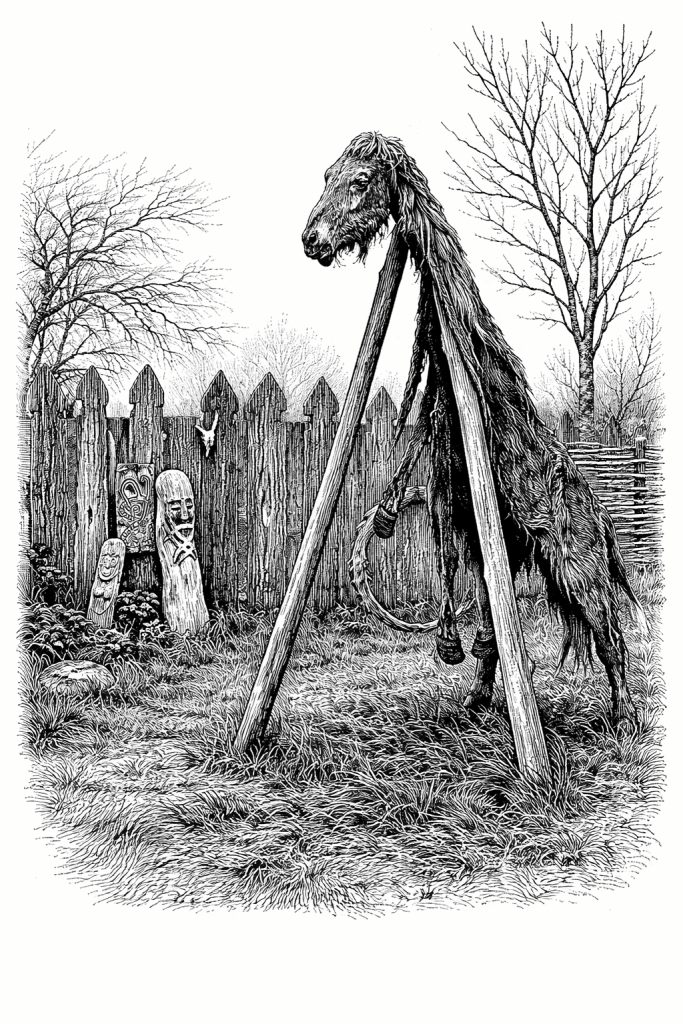
Níð did not belong only to speech. It could also be made visible. One famous example appears in Egils saga, where Egill takes a hazel-pole, fixes a horse’s head on it, speaks a curse against King Eiríkr and Queen Gunnhildr, turns the horse’s head toward the land, and carves runes on the pole expressing the curse. In English translation the saga calls it a “curse-pole,” but this episode is widely understood as the classic example of the níðstöng, a pole of scorn or dishonor.[5] Here the act is public, symbolic, and reputational all at once: it is not private malice but a dramatic statement aimed outward at rulers and even at the land’s guardian spirits.
This matters because it shows that níð was not confined to verbal insult. It could be enacted through ritualized display. Scholarship on Old Norse insult has long emphasized this mixture of verbal and visual modes.[1][5] That mixture fits well with the wider saga world, where public meaning is often attached to crafted speech, poetry, gesture, and symbolic acts. In other words, honor culture in the Old Norse record was not only a matter of emotion; it was a matter of signs that others could witness, interpret, and respond to.
Comparative perspectives on honor culture
Comparative scholarship is useful here, so long as it is used carefully. Bauman explicitly places Icelandic evidence into conversation with broader anthropological work on honor and shame, citing Michael Herzfeld’s caution about the use of “honor” as an analytical gloss while still arguing that Icelandic material belongs in that comparative conversation.[1] He also stresses something particularly important for the Norse evidence: honor is not only structural, but performative. Publicly artful speech, formal insult, praise, boasting, arbitration, and ceremonial interaction all help make moral standing visible.[1]
That comparative angle helps modern readers avoid two mistakes. The first is to treat Old Norse honor culture as irrational touchiness. The second is to romanticize it as pure heroic virtue. In practice, the sources show something more complicated: a society in which public reputation had real legal, social, and economic consequences, and where speech itself could wound, obligate, or expose.[1] Honor cultures elsewhere have shown similar dynamics, but the Norse evidence is distinctive in how strongly it ties those dynamics to feud, law, poetry, and the harsh logic of social adequacy.[4]
Níð, honor, and moral complexity
It is also worth saying plainly that Old Norse honor culture should not be flattened into a timeless moral ideal. The surviving texts are medieval literary works, often written after Christianization, and they preserve a world that is already being interpreted, remembered, and reshaped. Scholars therefore read them critically, not as transparent recordings of Viking-Age practice but as valuable witnesses to social values, tensions, and remembered norms.[1][2] That is one reason studies of níð, ergi, and honor continue to be debated: the material is rich, but it is not simple.
Still, the broad picture is clear enough. In the Old Norse world, honor was public standing; shame was public diminishment; and níð was one of the sharpest tools by which that diminishment could be inflicted. It attacked not only reputation but recognized personhood. Its force came from the same social order that made courage, effective action, and verbal command into visible measures of worth.[2][6]
A concluding note on Drengsiðr
Only at the end does this bring us to Drengsiðr. If Drengsiðr speaks of honor, reputation, oath-keeping, and character, it should do so with care. The Old Norse material shows that honor culture was real, serious, and socially formative, but also severe, hierarchical, and sometimes cruel.[1][4] A modern Heathen tradition can learn from its emphasis on public integrity, courage, truthful speech, and accountability, without simply reproducing every social assumption of medieval Scandinavia. In that sense, the study of níð is useful not because it gives us a practice to imitate, but because it reveals how deeply earlier Germanic societies connected word, reputation, and moral standing. That insight speaks directly to Drengsiðr’s concern with character and the weight of one’s name.
Footnotes
[1] Richard Bauman, “Performance and Honor in 13th-Century Iceland.” Bauman argues that honor and verbal performance in Icelandic society formed an integrated system and places the material in dialogue with comparative honor-and-shame scholarship.
[2] Folke Ström, Níð, Ergi and Old Norse Moral Attitudes. This remains a foundational study for the relationship between níð, ergi, and Old Norse moral thought.
[3] Anita Finlay, “An Exchange of ýki in Bjarnar saga Hítdœlakappa.” Finlay reproduces and discusses the Grágás passage on ragr, stroðinn, and sorðinn, and summarizes the scholarly association of níð with ergi, effeminacy, cowardice, and moral baseness.
[4] Carol J. Clover, “Regardless of Sex: Men, Women, and Power in Early Northern Europe.” Clover’s essay is central for understanding how status, power, masculinity, and social adequacy operate in early northern sources, including the idea that a strong woman could rise while a weak man could fall.
[5] Egils saga preserves the classic scene of the horse-headed pole usually identified as a níðstöng, showing that níð could be enacted symbolically and publicly, not only spoken.
[6] On Old Norse honor vocabulary, modern scholarship notes terms such as virðing, sómi, mannvirðing, and sæmd, with skömm as a common term for shame or loss of honor.
 Drengsiðr
Leave a comment